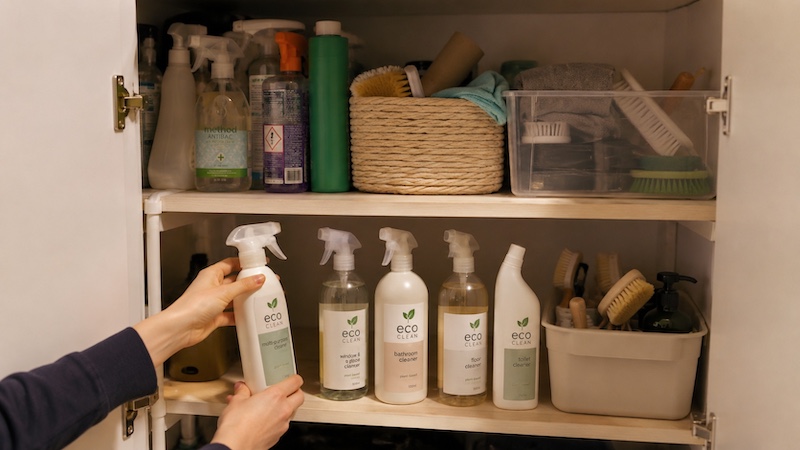
This is the real reason most businesses stay with products they’re not completely happy with.
Not because the products are great.
Because switching feels like effort.
Reviewing what you use.
Trialling something new.
Training staff.
Updating your cleaning schedules.
Dealing with a new supplier.
All of that sounds like a Tuesday afternoon you don’t have.
I get it.
So let me tell you what the switch actually looks like.
Step one: figure out what you’re using
Most businesses are running four to eight core cleaning products.
Degreaser, sanitiser, glass cleaner, floor cleaner, bathroom cleaner, or something similar.
You probably don’t need to replace all of them at once.
In fact, I’d recommend against it.
Start with the highest-use products or the ones used in the highest-risk areas, food contact surfaces, child contact surfaces, whatever matters most in your context.
That’s a manageable scope.
Step two: trial before you commit
I offer samples.
That’s not a throwaway line, it’s how I prefer to work.
You try the product in your actual environment, on your actual surfaces, with your actual staff.
Not a brochure.
Not my word for it.
If it doesn’t perform, you haven’t lost anything.
If it does, you’ve already done the trial.
Step three: the paperwork
If you’re in food service or childcare, you’ll need to update your cleaning schedule documentation to reflect new products, dilution ratios, contact times, appropriate surfaces.
That sounds annoying.
It’s actually about twenty minutes of work once you know the products.
I provide all the product information you need to do this.
SDS sheets, dilution guides, surface compatibility.
The documentation exists, you don’t have to chase it.
Step four: tell your staff
This is the most important step and the one people most often skip.
Staff will revert to old habits if nobody explains why things changed and how to use the new products.
A five-minute briefing, here’s what we’re using now, here’s the dilution ratio, here’s why, is all it takes.
The products aren’t complicated to use.
They just need to be introduced properly.
What you don’t have to do
Sign a contract.
Hit a minimum order.
Commit to a volume you’re not sure about.
I work with small and medium businesses.
I’m not running a volume game.
If you want to start with one product and see how it goes, that’s fine.
Still sounds like effort?
Fair.
Here’s the honest version: there is a small amount of effort involved.
A few emails.
A product trial.
A staff briefing.
That’s it.
If you’ve been putting it off because it seemed bigger than that, it isn’t.
Request a sample. Let’s start small.
— Cameron
Cameron Blewett runs Epiktet Supplies, the Victorian distributor for Evolution Organics.
Ready to try one product and see how it goes?